RealGM Analysis
As we approach the completion of lap one in the mile long run that is the professional baseball season, it is that time of year to delve into one of my favorite subjects, overachievers. Every season, it seems as if we uncover new stars that we never saw coming. Herein lies one of the greatest aspects of baseball. For every Jason Heyward, a star in the making that everyone saw shining brightly far before he arrived at the major league level, you have an Andres Torres type, a career journeyman for whom something just clicked. For every Buster Posey, there is a Jose Bautista, and so on and so forth.
It really is amazing, what with the throngs of scouts scouring the country for the next big thing, how little guarantee there is for what any player will achieve once he reaches the major league level. Now, one of the simplest ways of determining whether a player is overachieving is comparing his salary to his production. Last season, we saw the arrival of Bautista and Torres as significant contributors, as well as other Bang for Your Buck All Stars like Joey Votto, Angel Pagan, Aubrey Huff and Evan Longoria who all had a common thread: they all produced results that far outweighed what their paycheck reflected.
The method of comparison used last season was a little something I “developed” called the PARAS Factor, which consists of determining the percentage of a player’s salary in relation to Alex Rodriguez’s annual salary. While A-Rod still currently resides at the top of the list of highest paid baseball players in 2011 with a $31 million salary, we will, thus, use the same measuring stick. As a testament to the inequity of professional ballplayers’ salaries, last season’s Bang for Your Buck All Stars combined to earn 27.4% of what Alex Rodriguez hauled in in 2010. Conversely, they combined to produce 37.9 WAR (according to fangraphs.com) to A-Rod’s 3.9, with each and every last one of them individually outpacing the almighty Rodriguez on their own.
Let’s take a look at this year’s performers that are giving their employers the most clout for their coin, all of whom are on track to eclipse five WAR for the season at their current pace:
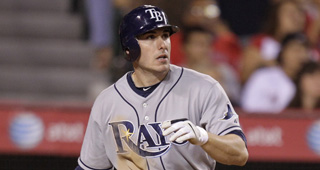
Matt Joyce – At first glance, it may appear that Joyce is a little old to just now become a useful regular at the major league level. He will turn 27 later this season, but he is more a victim of the Rays’ hesitance to promote prospects before they are 100% ready to contribute at the major league level rather than a slow developer. In 835 plate appearances at the AAA level during his career, he produced an .877 OPS, so he has at least proven that he should be given an opportunity in Tampa. However, the big club has been employing the likes of B.J. Upton, Carl Crawford, Ben Zobrist, et al in the outfield, so he really has been blocked.
In 2011, he is making the most of his chance to shine, having produced 1.6 WAR and a 1.002 OPS thus far as the Rays’ primary right fielder. Joyce is the type of player that you might call baseball’s version of a renaissance man, as he does almost everything well, but isn’t a superstar at any particular aspect of the game. While his batting average won’t likely stay at a league-leading .360, it is a great start for a guy who didn’t really figure to get the bulk of the playing time at his current position. That all changed when Manny Ramirez abruptly retired as he faced a certain suspension. With Joyce and The Legend of Sam Fuld, the Rays will be riding their hot hands until further notice.
PARAS Factor: 1.38%
Ike Davis – Ever since seeing Davis at the major league level a few weeks into 2010, I have been a big fan of his game. He is a slick-fielding first baseman with patience and power, and he has settled in as a fixture for now and the foreseeable future in New York. Although he hit 19 home runs last season in what essentially ended up being a full season, a lot of people expected a little more pop than the .440 slugging percentage he accumulated. That slugging percentage is up over .100 points to .543 in early 2011. He has also slugged seven home runs so far, good for one every 18.4 at bats, compared to one every 27.5 at bats in 2010.
Unfortunately for Mets fans, Davis went down with an ankle injury and will be out of commission until at least May 26. Rest assured, it appears to be a minor injury and shouldn’t be too big a bump in the road in what has started out to be a very successful sophomore season. If Davis can maintain somewhere in the neighborhood of a .900 OPS to couple with his superior glovework, it won’t be long until he is considered one of the better all-around first basemen in the game. Plus, he is just plain fun to watch swing a bat.
PARAS Factor: 1.38%
Gaby Sanchez – For those of you that thought the 2010 version of Sanchez was playing a little over his head, he has started out 2011 putting up better numbers across the board. In fact, he is walking more, striking out less and hitting for more power than he did in his first full season. Sanchez isn’t flashy, but he gets the job done. He currently ranks second to Joey Votto among National League first baseman in WAR, impressively outpacing such perennial stalwarts as Albert Pujols, Ryan Howard and Prince Fielder . Granted, it will be tough to keep up this kind of success over the long haul, but being able to boast superiority, even if it is only one quarter of a season, over those household names is a reason to hold one’s head high.
PARAS Factor: 1.39%
Colby Rasmus – Perhaps the most exciting, up-and-coming two way position player in the National League, Rasmus is a terror on both sides of the ball. After disagreements with manager Tony LaRussa and others in the organization last year threatened to sour their relationship, the Cardinals and their potential superstar center fielder seem to have put the past behind. Rasmus flashed some of the power that many have theorized that he is capable of in the first couple weeks of 2011, having compiled a .655 slugging percentage in the first 14 games of the season.
While he has been able to keep his batting average and on base percentage at impressive levels, .30 and .393, respectively, the power he displayed early has vanished. Rasmus has a total of six extra base hits over his past 99 plate appearances, a far cry from the nine extra base hits in his first 66 trips to the plate. While struggling to find consistency at the plate will continue be an issue that Rasmus will have to deal with at this stage in his career, he will always be able to positively affect the outcome of games with his glove. A center fielder with range to spare, the sky is the limit with regards to how good a ballplayer Rasmus can be. For now, he will continue to provide massive returns at a modest $443,000 salary.
PARAS Factor: 1.43%
Jeff Francoeur – I can say with 100% certainty that this is one name that I never expected would be included in this piece before this season started. Francoeur, however, has done everything in his power to force his way in. Power is the key word here, as he has mashed eight home runs thus far, good for one every 20.6 plate appearances compared to his career average of one every 33 trips to the plate. Playing for his fourth team since 2009, Francoeur hasn’t been able to stick in one place due to, among other things, his lackluster plate discipline, limited range in the outfield and inability to hit for average. In fact, it’s quite puzzling why he has gotten the chance to accumulate enough at-bats to even be considered a regular over the past three full seasons.
Francoeur’s plate discipline seems to be one aspect of his game that may have changed, as he has swung at far less balls than he is accustomed to in his career. In fact, he has swung at 51.8% of the pitches thrown to him this year, which is almost seven percent less than his career average. It remains to be seen if this is a development that will stand the test of an entire season, but it is certainly an encouraging sign for Royals fans. In his five full years at the major league level, Francoeur has never put together a full season of above average production at the plate. I wouldn’t bet on it, but you never know, this could be the year.
PARAS Factor: 8.06%
Howie Kendrick – To give you an accurate portrayal of the type of season Kendrick is having in 2011, one good indication is that he has already produced 2.4 WAR. The kicker is, that is more than he has produced in any of his previous individual seasons. The Angels have continued to have high hopes for Kendrick over the years, as they have done everything in their power to hand him the regular second base job. It appears like this may finally be the season in which everything clicks. The difference this season is that he has played other positions, having started seven games at first base and even four in left field.
Contributing to his career-high WAR figure, Kendrick has supplied more power (.513 slugging percentage), more plate discipline (7.9% walk percentage) and, although a very, very small sample size, is even playing the best defense of his career according to UZR/150, at 21.4. He is even four for four in stolen base attempts, completing the all around package that the Angels have been expecting from him in years past. If the Angels expect to keep pace over the long haul with the Rangers and the A’s in the AL West, especially without slugging first baseman Kendry Morales, having Kendrick fulfill his vast potential will go a long way toward that goal.
PARAS Factor: 10.65%
More stories: