RealGM Analysis
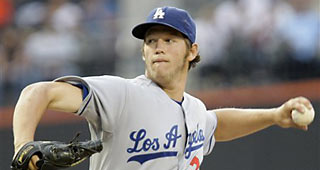
The Dodgers paid a 23-year-old Clayton Kershaw just $500,000 last season and reaped more rewards than they could have ever hoped for – watching him win the National League Cy Young award in his fourth professional season.
Kershaw will earn 15 times that this coming season, but if he is even 75% of what he was last year, the Dodgers will earn another very good return on their investment.
Los Angeles avoided arbitration with their baby-faced ace by agreeing to a two-year, $19 million deal this past week. Kershaw will make $7.5 million in 2012, with $2 million of that sum deferred to January 2013. When you take his $500,000 signing bonus into account, his salary this year becomes $8 million.
Next season, his salary jumps to $11 million.
We shy away from grading arbitration rulings here at RealGM because of the decisive nature of the result and deals that allow a player and team to avoid a hearing are generally quite similar.
Last month, Kershaw filed an arbitration figure of $10 million, while the Dodgers submitted a figure of $6.5 million. The midpoint of those figures ($8.25 million) is slightly higher than what he will earn in 2012, a minor victory for a team that could use one heading into a new era of ownership.
This contract is incredibly team-friendly, even more so than the two-year, $23 million deal Tim Lincecum signed with the Giants two years ago when he first became eligible for arbitration. Even without “inflation” taken into account, the Dodgers are paying $5 million less for their workhorse two years later.
Kershaw didn’t just win the Cy Young in 2011, he went 21-5 for a Dodgers team that finished just three games over .500 and won the pitching version of the Triple Crown by leading the National League wins (tie), strikeouts (248) and ERA (2.28).
You could make the argument that he was the best pitcher in baseball last year with Justin Verlander (24-5, 2.40 ERA, 250 Ks) either first himself or a very close second. For the sake of comparison, let’s just give the No. 1 nod to Verlander and rank Kershaw second.
His $500,000 salary is shocking when you look at his numbers, but not when you consider baseball’s economic structure. Players tend to be vastly underpaid as young elites and then grossly overpaid as they hit the downside of their career in-or-around their second free-agent contract.
Johan Santana is a good example of that. If he was healthy, he might be worth the $20 million the Mets paid him last year, but he wasn’t. His salary was the second-highest among pitcher’s, behind only CC Sabathia. If baseball had a salary slotting system, you could make the argument that Kershaw, as the best lefty in the game, deserved that $20 million.
Santana knows how the system works. He made just $1.6 million in 2003, when he finished seventh in the American League Cy Young voting in his fourth professional season. He was underpaid early in his career too.
Kershaw isn’t a one-season wonder either, having made 30 or more starts in three consecutive years without his ERA above 2.91, fewer than 185 strikeouts or a losing record on the mound. For his career, the Texas native is 47-28 with 745 strikeouts and a 2.88 ERA in 116 starts (179.1 innings). He works with four pitches – a fastball, curve, slider and change – and isn’t afraid to use his heater to blow by hitters in the strike zone.
Having locked up Matt Kemp with an eight-year deal back in November, the Dodgers have their two-best players under contract for the next two seasons. That isn’t forever, but it does eat up two of the pitcher’s arbitration seasons. He’ll be able to file for a final time after the 2013 season before he has the potential to hit the free agent market after the 2014 season.
A long-term contract could have erased a few of those free agent years as well, but a team with Frank McCourt-induced issues will have to get by having signed a young, dominant left-hander to a very affordable two-year deal.
The Dodgers weren’t bad in 2011, having won 82 games, but Kershaw was still responsible for a little more than a quarter of their victories. They won two additional games when he started but didn’t factor into the decision.
Verlander was responsible for about a quarter of his team’s wins as well, but Kershaw has him by a few percentage points. Sabathia won 19 games for the Yankees, less than 20% of the team’s haul for 2011.
Grade for Dodgers: A+
The Dodgers are paying below open market value for Kershaw, benefiting from a contract model and arbitration process that heavily favors older players.
Kershaw isn’t getting a “bad” deal in the sense that it’s a huge increase over his 2011 salary, gives him two years of security and is a heck of a lot more than most young professionals his age are earning. There are no finite expiration dates on the athletes, so it’s impossible to know whether a pitcher will be effective for two decades or two years.
Even if he struggles mightily for some unforeseen reason, which appears incredibly unlikely, he has earned himself a nice chuck of change.
Grade for Kershaw: A-
Two years from now he’ll either sign a long-term deal with the Dodgers worth well over $100 million or be rewarded a near-record salary in arbitration.
Andrew Perna writes on the MLB and NBA for RealGM.
Follow @Andrew_Perna on Twitter.