RealGM Analysis
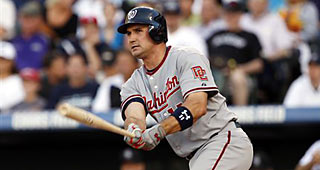
The contract came a day late, but the Washington Nationals extended the pact of Ryan Zimmerman on Sunday in the form of six years and $100 million.
Zimmerman was hoping to have his contract situation resolved by Saturday, but ultimately extended his self-imposed deadline 24 hours when Washington granted him a full no-trade clause. His previous deal was set to expire after the 2013 season and he can now remain with the franchise through 2020.
If the seventh-year option on the contract is picked up, Zimmerman will earn $150 million over the next nine seasons. He’ll remain a relative bargain for two years, when he’ll earn an average of $13 million annually. However, over the life of what has now become at least an eight-year pact, only Alex Rodriguez will earn more at third base.
Zimmerman didn’t want to distract the Nationals with his contract talks and potential rumors, which is why he set a deadline as players tend to do these days. Having signed Edwin Jackson and traded for Gio Gonzalez, Washington is hoping to make noise in the National League East sooner rather than later.
Right now, Zimmerman is the team’s premier player and his salary confirms that. Unfortunately for general manager Mike Rizzo and the team’s faithful, there is someone on the roster making more per year. It isn’t Stephen Strasburg or emerging phenom Bryce Harper either, it’s disappointing outfielder Jayson Werth.
Grade for Zimmerman: A
Even if Werth continues to frustrate, the Nationals are on the upswing.
They have a deep starting rotation and a growing lineup that could be bolstered by the Major League debut of Harper, the game’s consensus top prospect, as soon as this April.
But will Zimmerman’s contract handicap the team going forward?
He is one of only six players signed through 2019, joining Albert Pujols, Prince Fielder, Troy Tulowitzki, Ryan Braun and Matt Kemp. At first glance, one wouldn’t put Zimmerman in the same company as those superstars even though he has been a consistent threat for Washington since 2006.
He is a tremendous fastball hitter and has only been neutralized by a right-handed slider. Zimmerman is equally adept at hitting both southpaws and righties and sprays the ball all over the outfield. In 2011, he hit 19% of his flyballs to left, 18% to center and 24% to right. He does tend to ground out to third, as you might expect, hitting 64% of his grounders to his defensive equivalent.
Thanks to guys like Mark Reynolds, Evan Longoria, Miguel Cabrera (new at the hot corner) and countless others, third base has become a position of power. Zimmerman was limited to 101 games last year, but played 142 in 2010. In terms of third baseman, he ranked sixth in home runs (25), eighth in RBI (85), second in on-base percentage (.388) and third in slugging (.510) that year.
He is not a clear-cut choice as the game’s second best at the position, which is what his new contract suggests.
There is a lot of talent at third base, but the drop-off is rather steep. Three third baseman hit more than 30 home runs in 2011, but just five others had more than fifteen. That does somewhat justify Washington overpaying a bit to retain their homegrown product.
The truth is that he has been elite when healthy, but injured all too often for a contract of this sort. He has played in 150 games just three out of his six full big league seasons and missed a total of 147 contests since 2006.
Zimmerman wouldn’t sign the deal without a no-trade clause because he wants to spend his entire career with the Nationals. A contract of this magnitude could hamstring a franchise that lacks a history of winning.
Grade for Nationals: C
The inability to trade Zimmerman won’t be a problem over the next few years, but around 2017 parting ways with the slugger might be beneficial. Even though the Nationals have shown the ability to dish out huge sums of cash, trading an expensive, aging slugger to a contender for prospects is a smart move for any type of team.
With that said, Rizzo and the Nationals don’t plan on needing to make such a deal.
Andrew Perna writes on the MLB and NBA for RealGM.
Follow @Andrew_Perna on Twitter.