We are mere weeks away from another hot stove league in Major League Baseball, which is, for some, the most exciting aspect of the sport that does not occur on the diamond. In fact, it may have already started, given that there may be some sort of player compensation involved in the Theo Epstein to the Chicago Cubs deal that is currently in the works. However, the actual free agent and trade market does not truly get under way until roughly a week after the conclusion of the World Series.
While predicting free agent destinations is one of the most discussed topics on the baseball-related interwebs, it is far from an exact science and, for the most part, results in wasted server space. For my money, potential trades and trade targets are a much more entertaining lot. One of the more popular types of trades involves players in the last year of their contract. The primary reason for this tends to be that certain teams that do not necessarily think they will be in the playoff hunt in the following season can flip these players for prospects or younger major leaguers that will be controlled by the team for many years to come. The goal is to strengthen a team for the future and acquire players with an eye towards a point in time when the team will actually be in contention.
In order to analyze this kind of potential trade, the most logical place to look for players of this ilk is the bottom of the standings, as teams that performed terribly in 2011 stand a good chance to do the same in the following season. What I did is look at the rosters of teams in the bottom half of the overall MLB standings and pluck out all of the players who will either be free agents after 2012 or have a club option for 2013, since these types of options tend to get declined. I then compare the 2012 salary with their 2011 performance, in terms of WAR (according to fangraphs, of course).
This analysis yields some interesting results. For instance, would you believe that, of the players that fall into the category outlined above, none other than former Yankees and Braves whipping boy Melky Cabrera supplied his team with the highest WAR figure? Of course, no one can know what Cabrera will do in 2012, but recent performance is all we have to go on. Surely, the players who performed the best in 2011, relative to their 2012 salary (or projected salary in the case of arbitration eligible players), will have the highest trade value on the market. Value is what teams are looking for and what potential trade partners are looking to acquire in exchange for cost-controlled players.
For the purposes of articulating this analysis rather than simply pasting the results below, I will focus on the top ten players in terms of 2011 WAR per million dollars of 2012 salary. I will paste the full results at the bottom if you are interested in reviewing them. Here goes:
10. Carlos Quentin, Chicago White Sox, RF/LF (0.40 2011 WAR/million dollars of 2012 salary)
One of the most tantalizing players in the major leagues, the value of Quentin is primarily restricted by his ability, or lack thereof, to stay on the field. Injuries are a major concern for anyone looking to trade for the powerful outfielder. However, if he stays healthy throughout the entirety of a season, his employer will likely have a corner outfielder in the upper echelon of offensive performance. His fielding prowess leaves a lot to be desired, but if he can live up to his offensive potential, it will far outweigh his lackluster glove. Quentin will earn somewhere in the neighborhood of $6.5 million in his final year of arbitration, give or take a half million, and produced 2.7 WAR in 118 games.
As an interesting side note, the Chicago White Sox have three players in this top ten and seven out of the 43 that were included. It seems like this could be an offseason that the south siders could cash in some chips to replenish a severely depleted farm system. However, with the large financial commitments made last offseason to the likes of Adam Dunn and Paul Konerko, it may be unlikely that Kenny Williams and company go down that road.
9. Scott Baker, Minnesota Twins, SP (0.42 WAR/$M)
A control pitcher with extreme fly ball tendencies, Baker has long been an underappreciated starter. In fact, over the past three seasons, he has a better FIP than John Danks, Ricky Romero and Johnny Cueto. Unfortunately for the Twins, Baker spent the majority of August and September of this past season on the shelf with elbow trouble, only returning for a couple relief appearances near the end of the year. With the success that pitchers have had in recent memory going from the AL to the NL, Baker could be an intriguing buy low candidate for a contending team in the senior circuit in need of starting pitching. He will be entering the final guaranteed year of a four year contract that will pay him $6.5 million in 2012, with a club option for 2013 at a salary of $9.25 million. These figures could be seen as bargains for a player who accumulated 2.7 WAR in only 134 2/3 innings in 2011.
8. John Danks, Chicago White Sox, SP (0.46 WAR/$M)
Three spots in and we are still looking for our first player who made it through 2011 unscathed, injury-wise, as Danks missed almost a month due to a minor oblique strain. However, in his five years at the major league level, Danks has averaged 30 starts per season, which should alleviate a lot of concerns regarding injury risk. Since 2008, he has pitched to a 3.77 ERA, a respectable 1.26 WHIP as well as a .247 batting average against, good for 12th among AL starters with at least 500 innings pitched. Danks is entering his final year of arbitration after earning $6 million in 2011, so any projection of his 2012 salary should be at least $7 million and probably more.
7. Gavin Floyd, Chicago White Sox, SP (0.51 WAR/$M)
The easy way to describe Floyd is that of the mirror image of his teammate that preceded him on this list, as his money maker resides on the right side of his body. When comparing their statistics, it is difficult to distinguish the two. So much so, in fact, that the White Sox offered the two the same contract extension back in 2009. Floyd signed the deal and Danks did not, opting to go the arbitration route. It proved to be slightly less lucrative for Floyd, as his deal pays him $15.5 million over the four year span, while Danks, with the $7 million estimate for 2012, will have earned just under $17 million. The White Sox do hold a 2013 club option on Floyd at the rate of $9.5 million, which seems to be pretty close to his projected free agent value. His might be one club option that does get picked up down the road.
6. R.A. Dickey, New York Mets, SP (0.53 WAR/$M)
If, for some deranged reason, you were trying to predict what this list would look like roughly two years ago, Dickey would probably be as unlikely a candidate as Jon Stewart is to secure the 2012 Republican presidential nomination. How is it possible that Dickey, in two years, has morphed into one of the best knuckleballers baseball has seen in several decades? The only logical answers appear to be the uncanny control he possesses with his primary weapon and his ridiculous consistency. From 2010 to 2011, his strikeout to walk ratio is exactly the same, at 2.48, his batting average against rose one point, from .247 to .248, and his average innings per start went from 6.66 to 6.49. Knuckleballers are supposed to be the most fickle of pitchers, but Dickey appears to be the exact opposite. At what point do you start counting on him to produce as he has been? He is under contract for 2012 at $4.75 million, but the Mets may be better served to shop his services to the highest bidder, as Citi Field does not look like it will be the home of a winning ballclub for at least a couple years.
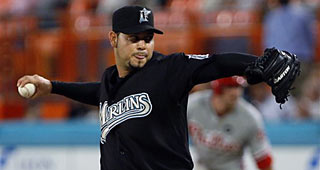
5. Anibal Sanchez, Florida Marlins, SP (0.58 WAR/$M)
A pitcher that has long frustrated Marlins fans with his inconsistencies, Sanchez appears to finally be coming into his own. Once thought of as the second fiddle in the Josh Beckett/Hanley Ramirez trade, he now has turned into one of the most productive starters in the NL. In fact, only seven starters in the senior circuit have provided their respective teams with more WAR over the past two seasons than Sanchez. With the Marlins opening a new stadium in 2012, it is doubtful that they will initiate one of their patented fire sales. So, Sanchez will likely be sticking around for at least the beginning of the season. He is entering his final year of arbitration and will likely make somewhere in the neighborhood of $6.5 million, so if he continues along the same lines of production, he will be a bargain in the coming season.
4. Ubaldo Jimenez, Cleveland Indians, SP (0.83 WAR/$M)
If you are familiar with his contract situation, then you are probably wondering why Jimenez is on this list. Yes, technically 2012 is the last guaranteed year on the four year contract he signed with the Rockies in 2009. However, he has two extremely team-friendly club options in 2013 and 2014 that are almost locks to be picked up by whichever club is employing him at that time. I thought it to be quite odd when news hit that Colorado was shopping their ace right-hander towards the trade deadline this season, seeing as they are usually hurting for pitching and looking to acquire it rather than dealing it away. Given his 2010 season, almost any performance this year would probably be considered a downgrade. However, his strikeout and walk rates were virtually identical to his dominant 2010, but he was victimized mainly by his inability to strand runners on base and the fact that he gave up the long ball at almost double the rate he did the year prior. With the unlikely success of Cleveland this season, it is hard to envision them shopping Jimenez and his ace potential in the offseason, but the fact that he is essentially under club control through 2014 at what could be bargain basement prices (as much as any number that ends in “million” could be considered a bargain) could entice a faltering 2012 Indians club to cash in and load up on some prospects.
3. Sean Marshall, Chicago Cubs, RP (0.90 WAR/$M)
Averaging 79 appearances over the past two seasons, would you believe that WAR pegs Marshall as the most productive relief pitcher in all of baseball over the same span? I certainly wouldn not have guessed it. It is quite shocking to pull that list up and see his name followed by the likes of Jonathan Papelbon, Mariano Rivera and John Axford. It goes to show you that sometimes you need to look beyond the closer roles to find the most productive relievers. Marshall is unique in the respect that he does not achieve his relief success by way of a dominant fastball, rather he wears out opponents with a devastating curveball and an incredibly effective cutter. In the final year of a two year contract, he will earn $3.1 million to toil his wares in the windy city. However, the lovable losers appear to be staring down the road at another season of doing just that, losing. So, a reliever as effective as Marshall will have good value on the trade market, especially due to his left-handedness and his ability to pitch effectively to both lefties and righties.
2. Chris Iannetta, Colorado Rockies, C (0.91 WAR/$M)
After a tumultuous 2010 season that saw his stock plummet, Iannetta turned in a successful 2011 campaign that went relatively unnoticed. Perhaps it was due to his lackluster batting average, which ended the season at a paltry .238. However, his keen batting eye helped him finish the season fourth among major league catchers with at least 400 plate appearances in on-base-percentage. Regardless of whether you subscribe to traditional or sabermetric statistics, a catcher that can get on base at a 37% clip is a valuable asset to any team. Iannetta also possesses some power (his hefty build suggests there could be more power hidden there somewhere), leading some to believe that his best years in the big leagues are still ahead of him. He is under contract for $3.63 million in 2012 with a club option for 2013 at a salary of $5 million. If he can repeat his 2011 season, his option will almost surely be picked up, but the option has a hitch. If Iannetta is traded before 2013, he has the ability to void the option, which decreases his trade value rather considerably.
1. Melky Cabrera, Kansas City Royals, CF (1.05 WAR/$M)
I honestly cannot envision a scenario where I would have placed Cabrera at the top of any list I was creating, but, alas, here he stands. For as much vitriol that has been spewed on message boards in the past aimed at Cabrera, it had to feel good for him to enjoy the type of sustained success he had in 2011. As the Royals primary center fielder, he had the best season of his career in virtually all aspects of the game. Cabrera is never going to win any gold gloves, but if he can hold down center field and supply the kind of offense he did this season, he provides his employer with a ton of value. While the future of the Royals is bright with all of the young talent that they have streaming to the major league level, it is unlikely that Cabrera will be a part of the next winning team in Kansas City. If the Royals are able to obtain a decent prospect or two in exchange for his services this offseason, my guess is that they will pull the trigger. Cabrera is heading into his final year of arbitration and projects to earn in the neighborhood of $4 million. If he has a year anywhere near his 2011 season in 2012, his team will certainly be happy to have him around.
Below is the full list of the findings. As you could have guessed, players with large salaries tend to be towards the bottom of the list. Especially if their 2011 performances lacked the pizzazz that earned them the contract in the first place, and yes, I am talking to you, Carlos Lee, Carlos Zambrano and Ichiro Suzuki. If any of these types of players have any chance of being traded, their current teams will need to pitch in some hefty sums of money to offset their salary. How much that is will largely depend on the quality of prospect(s) that are sent to the team in return. Enjoy the hot stove, everybody!
| Team | Player | 2012 Salary (in Millions) | 2011 WAR |
|---|
| Royals | Melky Cabrera | Arb | 4.2 |
| Marlins | Anibal Sanchez | Arb | 3.8 |
| White Sox | Gavin Floyd (club option) | 7 | 3.6 |
| Indians | Ubaldo Jimenez (club options) | 4.2 | 3.5 |
| Rockies | Chris Iannetta (club option) | 3.63 | 3.3 |
| White Sox | John Danks | Arb | 3.2 |
| Astros | Carlos Lee | 18.5 | 3.2 |
| White Sox | Jake Peavy (club option) | 17 | 2.9 |
| Twins | Carl Pavano | 8.5 | 2.9 |
| Cubs | Ryan Dempster | 14 | 2.8 |
| Cubs | Sean Marshall | 3.1 | 2.8 |
| Twins | Scott Baker (club option) | 6.5 | 2.7 |
| White Sox | Carlos Quentin | Arb | 2.6 |
| Mets | R.A. Dickey (club option) | 4.75 | 2.5 |
| Orioles | Jeremy Guthrie | Arb | 2.1 |
| Cubs | Marlon Byrd | 6.5 | 2 |
| Mets | David Wright (club option) | 15.25 | 1.9 |
| Padres | Jason Bartlett (club option) | 5.5 | 1.8 |
| Padres | Orlando Hudson (club option) | 5.5 | 1.8 |
| White Sox | AJ Pierzynski | 6 | 1.7 |
| Astros | Brett Myers (club option) | 12 | 1.5 |
| Mariners | Brandon League | Arb | 1.4 |
| Rockies | Matt Belisle | 3.77 | 1.3 |
| Reds | Scott Rolen | 6.5 | 1.3 |
| Indians | Travis Hafner (club option) | 13 | 1.3 |
| Twins | Francisco Liriano | Arb | 1 |
| Mets | Angel Pagan | Arb | 0.9 |
| Mariners | Miguel Olivo (club option) | 3.75 | 0.9 |
| Cubs | Carlos Zambrano | 18 | 0.9 |
| Rockies | Matt Lindstrom (club option) | 3.6 | 0.8 |
| Rockies | Huston Street (club option) | 7.5 | 0.5 |
| Athletics | Grant Balfour (club option) | 4 | 0.4 |
| Orioles | Mark Reynolds (club option) | 7.833 | 0.3 |
| White Sox | Will Ohman | 2.5 | 0.2 |
| Marlins | Leo Nunez* | Arb | 0.2 |
| Mariners | Ichiro Suzuki | 17 | 0.2 |
| White Sox | Tony Pena | Arb | 0.1 |
| Marlins | Randy Choate | 1.5 | 0.1 |
| Athletics | Brian Fuentes (club option) | 5 | 0.1 |
| Pirates | Kevin Correia | 3 | 0 |
| Orioles | Luke Scott | Arb | -0.1 |
| Padres | Pat Neshek | Arb | -0.7 |
| Astros | Brandon Lyon | 5.5 | -0.7 |
| Rockies | Ryan Spilborghs | Arb | -1.1 |

 RealGM Analysis