?Tis the time of year for gift-giving, and this year I received a gift that will no doubt be something I cherish for my remaining years on this earth. Indeed a must have for the serious baseball fan, I am now the proud owner of Ken Burns? legendary documentary,
Baseball; all ten glorious innings of it. In case you didn?t know, Burns recently released the
Tenth Inning as an addendum to his already acclaimed film presumably because of the historical significance of the steroid era and the havoc it wreaked on the game?s hallowed record books.
I have seen many bits and pieces of the film over the years, but have never taken the time to sit through it in its entirety. So, last night, I started it from the beginning with the intention of (eventually) watching all 23 hours of it in the order it was meant to be consumed. As a side note, while I?m sure my wife is grateful to her father for bestowing such a gift upon our household, I really don?t think she has any idea the type of commitment such an undertaking is going to be.
Delving into the depths of rich history that America?s Pastime possesses is something that I have always enjoyed. It is easy to forget the decades and decades of athletes that came before my time, but it is also comforting to take a look back at the players and teams that our fathers and grandfathers considered their heroes. So, in honor of the most recent class of Cooperstown inductees being announced on January 5th, not to mention my wife putting up with the onslaught of baseball history for the next few weeks, I decided to take a look at some of the future hall of famers of today and draw a parallel to someone from baseball?s past. It is quite eerie to think about how similar two players from vastly different generations can be, but that is one of the beautiful aspects of this game. The fundamental rules have not changed for the better part of roughly 130 years, allowing for this kind of comparison.
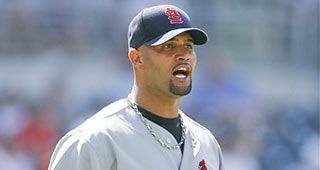
Future Hall of Famer: Albert Pujols
Since Barry Bonds retired (albeit involuntarily), Albert Pujols has cemented himself as the premier hitter in all of baseball. His accomplishments during the first decade of his career are nothing short of spectacular and will be viewed as such in any light whenever he decides his playing days are over. The sheer consistency with which he has performed should be praised in and of itself. The Cardinals? first baseman has never played in fewer than 143 games in any given season, and has appeared in at least 154 games eight out of ten years. This kind of durability from a superstar is an aspect of his overall game that only enhances his already herculean feats, not to mention the value he provides to his employer.
The all-around nature of his game is the thing that amazes me most about Pujols. Most prototypical sluggers can hit a ton of home runs, but that usually comes at the expense of striking out a lot. Not in this case. Pujols has averaged 41 home runs per season to go along with a .624 slugging percentage, but has only struck out in 11.3% of his at bats. For comparison?s sake, here are the strikeout rates of some of the other power hitters of this generation: Ryan Howard (32%), Prince Fielder (22.8%), Alex Rodriguez (20.8%), Jim Thome (30.9%), Adam Dunn (32.8%). Pujols has described himself as a line drive hitter who hits home runs. The fact that he won?t even call himself a home run hitter is a testament to his commitment to being a complete player.
As great as Pujols is, I honestly believe that the fans of this day and age are not fully appreciating what he is doing on the field. Keep in mind that he has never had a full season batting average lower than .312, an on base percentage below .394 or a slugging percentage below .561. He has produced an OPS over 1.000 in eight out of ten seasons and four times exceeding 1.100. There are very few that have been able to do what he is currently doing, so much so that the player I find most comparable in history might shock you.
Albert Pujols? brother from a distant mother: Lou Gehrig
There was a good reason why I started off the previous section with a statement about how durable Pujols has been, because it is very tough to match up with a player so durable that his nickname was ?The Iron Horse.? Outside of his legendary streak, Gehrig was as good an all-around hitter that the game had/has ever seen. If it weren?t for the guy that batted directly ahead of him in the lineup, then he would surely be in the discussion for best hitter of all time. The similarities between Gehrig and Pujols are downright scary. Obviously, they both played the same position, first base. Offensively, they are so close in nearly every category that one might think that Pujols is Gehrig reincarnated.
| BA | OBP | SLG | OPS | BB% | K% |
|---|
| Albert Pujols | 0.331 | 0.426 | 0.624 | 1.050 | 13.5% | 11.3% |
| Lou Gehrig | 0.34 | 0.447 | 0.632 | 1.080 | 15.6% | 9.9% |
Seeing as Gehrig holds a slight advantage in all categories coupled with the fact that he played in a much more offensively deprived era, the odds are stacked against him that Pujols will be able to wrestle away the title of greatest first baseman of all time. The fact that he is as close as he is to Gehrig?s numbers should drive home the historical significance of Pujols? feats. ?The Machine? already has a leg up on Gehrig with respect to Most Valuable Player awards, three to two, but that would likely not be the case if the MVP award hadn?t been abolished from 1928-1930. In fact, in the 11 years during Gehrig?s career in which there was an MVP award, he finished in the top five of voting in eight out of 11 seasons. In case you were wondering, Pujols has finished in the top five nine out of ten seasons.
Future Hall of Famer: Chipper Jones
When I was young, I distinctly remember watching Sports Center and thinking to myself, ?man, it feels like they?ve been talking about some kid named Chipper in the Braves? minor league system for years now. He better be good.? Turns out he was better than just good. The first pick in the 1990 amateur draft, Jones is one of the rare players to live up to the enormous amount of hype that followed his arrival at the major league level. A switch-hitting third baseman (for the most part) with power and patience, it was never a doubt that the Atlanta lifer, who has spent every day at the major league level playing under the legendary Bobby Cox, would succeed. It was more a matter of when.
Among third basemen all-time, Jones is second only to Alex Rodriguez in OPS. Longevity and consistency have been the hallmarks of his game, as Jones? peak performance seemingly lasted from 1995-2008. During this span, he posted an OPS of .955, averaged 29 home runs and accumulated more walks than strikeouts. No doubt one of the best players of his generation, it is yet again simply a matter of when, not if, Chipper Jones will be enshrined into Cooperstown.
Chipper Jones? brother from a distant mother: Dick Allen
Now, I may be slightly stretching here, given that Allen spent more time at first base during his career than third base, but the similarities are difficult to ignore. Needless to say, Allen played during an era when pitching reigned supreme and sluggers were few and far between. Often times, he finished the season ahead of such legends as Willie Mays, Willie McCovey, Roberto Clemente and Hank Aaron on the offensive leaderboards. During his peak years, 1964-1974, Allen ranked fifth in on-base percentage, second in slugging percentage, eighth in batting average, fifth in home runs and second in OPS. Amazingly, the rest of the top ten OPS leaders from that time period are in the Hall of Fame. Dick Allen is not. Likely due to his career being over before he turned 36, he wasn?t able to accumulate the volume of counting statistics that Hall of Fame voters prefer. However, his career statistics speak for themselves.
| BA | OBP | SLG | OPS | BB% | K% |
|---|
| Chipper Jones | 0.306 | 0.405 | 0.536 | 0.941 | 14.5% | 15.7% |
| Dick Allen | 0.292 | 0.378 | 0.534 | 0.912 | 12.2% | 24.6% |
Through the research I conducted for this piece, I have come to the conclusion that it is an absolute abomination that Allen is not in the Hall. It might be a legitimate knock against him that his career could have been longer than it was, but his eleven-year peak ranks up there with the luminaries of the sport. Some blame his reputation of having a tendency to be less than cordial, resulting in the writers (read: Hall of Fame voters) of his era not taking too kindly to him. That may be the biggest difference between Jones and Allen, because all of the data that is available to us leads me to believe that they are comparable players from two very different eras.
Future Hall of Famer: Ivan Rodriguez
In twenty seasons at the major league level, Ivan Rodriguez has established himself as one of the best two-way catchers of all time. From 1992 through 2001, Rodriguez, in his first ten full seasons, managed to get elected to the All-Star Game and win the gold glove each and every year. While these aren?t distinctions that should be used as the be all, end all of determining success, you would be hard-pressed to find someone who will disagree with the notion that Rodriguez was the best defensive backstop in the game during that time frame. That is what made it all the more astounding what he did with the bat. There were definitely better offensive catchers in history, but it is hard to say that many of them were better balanced at both facets of the game than Rodriguez.
Ivan Rodriguez?s brother from a distant mother: Carlton Fisk
It would be interesting to know whether Ivan Rodriguez got the nickname ?Pudge? because his game was so similar to his original nickname-sake or simply because he was pudgy. Regardless, the career numbers for this pair are so strikingly similar that it is no surprise that they were both the gold standard for catchers in their respective hey-day (Fisk had to share this distinction with the legendary Johnny Bench). Playing a position that demanded as much, both Pudges played the game with a tenacity befitting their spot on the field. The main difference between the two players lies in Fisk?s willingness to draw a walk and Rodriguez preference of swinging away. Nevertheless, both of their strategies work, as evidenced by the following table.
| BA | OBP | SLG | OPS | BB% | K% |
|---|
| Ivan Rodriguez | 0.298 | 0.334 | 0.466 | 0.800 | 5.0% | 15.3% |
| Carlton Fisk | 0.269 | 0.341 | 0.457 | 0.797 | 8.6% | 15.8% |
The most impressive thing about Fisk?s career may not be his offensive, defensive or even clubhouse contributions. It might simply be how long he was able to stick around at a position so physically demanding that most catchers call it quits by their mid-thirties or so. Fisk was able to play the catcher position, and play it well, until the ripe old age of 45. Take his 1988 campaign, for instance, when, albeit in roughly half a season, he produced a triple slash line of .277/.377/.542, for an OPS of .919 at the age of 40. If there was a better offensive season by a catcher at that age, I can?t find it.
Future Hall of Famer: Ichiro Suzuki
Raise your hand if you thought Ichiro would be a Hall of Fame candidate when he made the transition to Major League Baseball in 2001? No one?s hand should be up, because it just doesn?t make sense, logically, that a player who didn?t join the MLB until he was 27 would be able to get acclimated and immediately proceed to be the best at what he does. Off the top of my head, I can?t think of another player?s game you would be able to describe as poetic, but it absolutely fits the bill with respect to Ichiro. Everything he does on a baseball field appears to have a rhythm to it. From wielding his bat more like a wand than a piece of lumber to unleashing one of his trademark frozen rope throws from right field, watching Ichiro play the game is not unlike watching a master craftsman at work.
Playing the game in a poetic fashion is fine and dandy, but actual production is what puts an athlete in the same class as the all-time greats. Lucky for Ichiro, as well as Mariners fans for that matter, he has succeeded in that department as well. He is the first player in history to collect at least 200 hits in ten consecutive seasons, which just so happened to be his first ten seasons. Since 1961, the only players to have a higher career batting average than Ichiro are Tony Gwynn and Albert Pujols. Ichiro is the ultimate tablesetter, with his contact/speed game perfectly suited to the leadoff spot. He is so committed to getting on base that he appears to be three steps out of the batters? box by the time he makes contact with the ball.
Ichiro Suzuki?s brother from a distant mother: Willie Keeler
You have to go way back to find the most comparable player to Ichiro, but it is quite fitting that way seeing as he is quite the throwback of a player. In the First Inning of Ken Burns? documentary that spurned this piece, he describes Keeler as an expert at placing a batted ball wherever he wanted. It was here where I learned about the origin of a long-standing motto in baseball. Supposedly, when Keeler was asked his secret to success, he replied, ?Keep your eye clear, and hit 'em where they ain't.? The last part of that statement is something that I have heard since I was running around in Little League. While it was likely first spoken over a hundred years ago, it could just as easily be how Ichiro describes his own success. Keeler was so adept at handling the bat that, as legend has it, he was the reason for changing the rule that made a fouled bunt attempt with two strikes an out rather than just another foul ball. So, speed and contact were the foundation of Keeler?s offensive game and it showed in the statistics.
| BA | OBP | SLG | OPS | BB% | K% |
|---|
| Ichiro Suzuki | 0.331 | 0.376 | 0.430 | 0.806 | 6.2% | 10.1% |
| Willie Keeler | 0.341 | 0.388 | 0.415 | 0.802 | 5.5% | n/a |
Despite careers that were separated by 90 years, these two had a career OPS that differed by a mere 0.004 points. Both right fielders, both slender in build and both left-handed hitters, I can?t imagine it possible to find two more similar players so far removed from each other by time. Despite decades and decades of change all around us, a comparison like this serves to remind us that there is one institution that we can rely upon to remain static, and that is the sport of baseball.

 RealGM Analysis