RealGM Analysis
Around this time of the baseball season, you will no doubt come across numerous writers giving their takes on MVP, Cy Young and maybe even anti-MVP?s and anti-Cy Young?s. I plan to go in a completely different direction.
I developed a statistic designed to judge players against their peers, as well as put starting pitchers and position players on a level playing field. With apologies to the likes of Mariano Rivera, Billy Wagner and Hong-Chih Kuo, I do not include relief pitchers because I don?t believe they have any business winning a Cy Young Award or MVP under any circumstances. And isn?t that what a supposedly all-encompassing statistic is supposed to tell us, which player is the best (or worst, for that matter)?
What my player rating measures for batters is a combination of percentage better than league average they are in three different categories: batting average, on base percentage and slugging percentage.
For pitchers, I use batting average against, walks plus hits per inning pitched and earned run average.
There are weighted factors in both of the calculations so as to not have one category skew the results, but those will be my secret for now. Disclaimer: defensive ability plays no part whatsoever in the Player Rating.
I believe I have found a good blend of the different factors in the equation so as to be able to use the same scale to compare pitchers and hitters against each other. The cool thing about my player rating is the fact that it passes the eyeball test. As I scan up and down the leader board, all of the great hitters and pitchers are near the top and all of the dreadful performers are at the bottom.
I refuse to have the first application of my player rating be for a clich? cause, such as Player of the Year or Pitcher of the Year. Nay! Nor will it be used for determining something as depressing and insulting as Least Valuable Player or Belly Itcher of the Year. What I will do is introduce my player rating by identifying the Mid Valuable Player as well as the Andy Ashby Award (named after a pitcher whose career ERA, 4.12, is the exact midpoint of the 2010 NL and AL average ERA) for each league. For these purposes, the middle will be considered the median of data being looked at. Finally, the player who falls exactly in the middle of the overall player ratings will be dubbed Mr. Mediocre.
I will keep these rankings through the end of the season and present them as final in a column after the season?s conclusion. Minimum qualifications for these honors apply; pitchers must have at least 100 innings pitched and hitters are required to have accumulated no less than 320 plate appearances to date. In theory, the most average player ranking that a player could possibly have is 0.0 with the way my formula is concocted. However, by putting minimum qualifications in place, that midpoint gets increased in an effort to only include those who play on a fairly regular basis. For now, we are only looking at current totals that are sure to change in the season?s final three weeks. Until then, you?re current leaders for the awards are as follows:
National League Mid Valuable Player
Adam LaRoche ? A player so sought after that he was traded for twice in the last week of August last season, but that?s only one way to look at it, of course. He was also traded away by two teams as well. LaRoche has long been seen as a useful first baseman with some pop, but his stats have fallen off slightly in 2010 rendering him smack dab in the middle of the pack. Among some of his most ordinary numbers this season include an 8.3% walk percentage (0.16% away from league average), a .266 batting average (league average is .257) and 23 home runs (league average for first baseman with at least 320 plate appearances being 21.4). From what I can tell, he has earned this title.
NL MVP (according to Player Rating): Joey Votto,
NL Anti-MVP: Pedro Feliz
National League Andy Ashby Award
Jamie Moyer and Barry Zito ? The reason there are two leaders for this ?award? is that there are an even number of pitchers that are qualified at the moment. I assure you that I will tweak the qualifications at the conclusion of the season in order to avoid this for the final presentations. For now, I find these two to be an interesting pairing, in that both are similarly effective, soft-tossing lefties but have 16 years separating them in the age department. Lest you think I am downplaying the value of an average starting pitcher. After all, this pedestrian pair is getting paid a combined $25 million this season for peddling their run of the mill pitches.
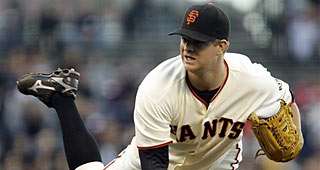
NL Cy Young Award: Matt Latos
NL Belly Itcher Award: Zach Duke
American League Mid Valuable Player
Alexei Ramirez ? The fact that Ramirez is such a free swinger is probably what is keeping him from faring better in the player rankings. Average production from the shortstop position is a quite attractive commodity, actually, especially since there is always an air of unfulfilled potential when you watch Ramirez at the plate. The power speed combo that he possesses is a rare and untapped resource due in large part to his lack of discipline. In a down year offensively for American League shortstops, Ramirez ranks second in OPS to a guy who is no longer even in the league in Alex Gonzalez. So, could it be that the most average offensive player in the AL is actually the best offensive player at his position?
AL MVP: Josh Hamilton
AL Anti-MVP: Justin Smoak
American League Andy Ashby Award
Ervin Santana and Gavin Floyd ? Floyd?s peripheral statistics suggest that he has been far better than average this season. In fact, according to fangraphs.com?s WAR statistic, he has been the eighth most valuable starting pitcher in the AL with at least 100 IP. He has not walked many batters (2.77 BB/9), he has kept the ball in the ballpark (0.64 HR/9) and he has induced more groundballs than he ever has in his career. However, the figures used to compute his player rating paint a different picture, as he is hovering around league average in batting average against, WHIP and ERA.
Santana, on the other hand, has been the model of mediocrity. He has eaten a bunch of innings posting such unremarkable numbers as a 4.00 ERA, exactly one hit per inning pitched and a shade under seven strikeouts per nine innings. None of these statistics scream ace, but, once again, starting pitchers who provide average production and eat 200+ innings in a season do not grow on trees. I?m sure the Angels organization is happy with Santana with a dose of optimism that he can one day regain his 2008 form in which he finished sixth in the Cy Young award balloting.
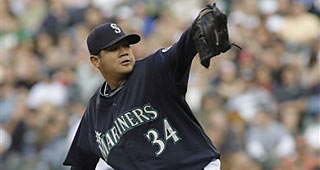
AL Cy Young Award: Felix Hernandez
AL Belly Itcher Award: Brian Bannister
Mr. Mediocre
Armando Galarraga ? When I was formulating the idea for this article, little did I know that the guy who should have the third perfect game of the season would be the poster boy. If you are able to put aside the sentimentality of the moment that wasn?t, you can take a look at Galarraga?s season and see that perfectly normal pitchers can, on any given day, accomplish extremely abnormal feats. Remarkably, he is less than 4.8% away from league average in all categories measure by Player Rating (batting average against, WHIP and ERA), and 1.4% or less in two out of the three categories. This, my friends, is what you call mediocre. Interestingly enough, Galarraga will be eligible for arbitration for the first time this offseason, so we will be able to see exactly how much mediocrity is worth.
Best overall Player Rating: Matt Latos
Worst Overall: Brian Bannister
I realize it was quite the cop-out to include the winners/losers of the traditional awards, but I couldn?t resist. Stay tuned for the postseason version of the final Player Ratings soon after the season?s completion.
Jason Follain is the Senior Baseball Writer for RealGM.com. Please feel free to send comments, suggestions and feedback to Jason Follain directly at [email protected]
More stories: