RealGM Analysis
The most valuable commodity a major league baseball team can have is young, cost-controlled players that are producing at a high level, whether it be pitchers or position players, and the Tampa Bay Rays have them in spades. Unlike their division foes, the Boston Red Sox and New York Yankees, the Rays don?t have the finances needed to pay top dollar on the free agent market. Rather, they must build from within and develop the talent they obtain through the draft.
While they did have the benefit of choosing at or near the top of the draft for the first decade of their existence, you cannot attribute their recent success to that alone. For comparison?s sake, the Pittsburgh Pirates have been mired in the dregs of sub-.500 records since the moment Barry Bonds left town and have yet to parlay that into even a winning season, much less contending to reach the playoffs.
A lot of the good things that you are able to say about the Rays of today are the same things that were being said about Oakland A?s a decade ago. Both teams worked within the constraints of a small budget compared to their contemporaries, and thus were forced to rely on deft drafting skills combined with talent development in their respective minor league system. These minor league systems both produced a top notch major league starting rotation, which became the focal point of each franchise and the envy of all others.
While young, cost-controlled players are what every team craves, it is the young starting pitcher that is the crown jewel of major league assets. The Oakland A?s went to the playoff four years in a row from 2000 through 2003 on the backs of what came to be known as the Big Three. During that four year period, Tim Hudson compiled an ERA of 3.26, Barry Zito clocked in at 3.12 and Mark Mulder rounded out the three at 3.77.
When I asked the only remaining Athletic from the days of the Big Three, Mark Ellis, about the comparison of two teams from different eras, he replied, ?It all starts with pitching. If you can pitch, you?re going to have a chance.?
The Rays no doubt have a chance, night in and night out.
While I?m sure the Rays? opponents wished their starting rotation was only three deep, that is far from the case. Some might say that Tampa Bay has a stable of youngsters that runs six and possibly even seven deep.
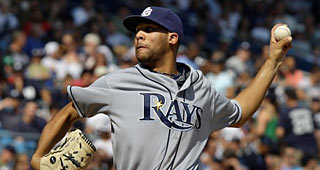
The starting five, whose average age is a fresh-faced 25.8 years old, is led by former number one overall pick of the 2007 amateur draft, David Price, who is making a solid pitch for the American League Cy Young award in his second full season at the age of 24. Price has baffled opponents this season to the tune of a 2.97 ERA while striking out 8.33 batters per nine innings. Opposing batters are also hitting a measly .230 off of him. All of this has been accomplished while primarily facing some of the stiffest competition in the major leagues in the American League East.
Matt Garza, who has anchored the Tampa Bay rotation for the past three seasons, is his usual, innings-eating self. The Rays? 26-year-old has contributed yet another solid performance season to date with a 3.74 ERA over 156 plus innings of work. Garza got off to a fantastic start to the season, reeling off three straight eight inning outings while only giving up a total of two earned runs. He cooled off after that, but has gotten back into the swing of things of late while compiling a 1.72 ERA and allowing a miniscule OPS of .497 to opposing batters over his past five starts.
Perhaps the unsung hero, Jeff Niemann has been as solid as any pitcher in the rotation. Also a former first round draft pick, Niemann has been the definition of steady while going at least six innings in all but two outings. Having compiled a 3.12 ERA in 22 starts while relying primarily on a heavy sinkerball that generates a lot of groundballs, Niemann is finally realizing his potential at age 27. He is currently on the disabled list recovering from a shoulder strain, but will return to the rotation this coming week. And if you?ve been paying attention to the standings, the Rays? staff hasn?t skipped a beat due to the fact that they have two pitchers in their bullpen that would be starting for most other teams in Jeremy Hellickson and Andy Sonnanstine.
The elder statesman of the group, James Shields, checks in at 28-years-old. His moniker of ?Big Game James? alone tells you what his teammates think of him despite his 4.82 ERA. Shields has cut his teeth in the AL East over the past five seasons, but in the 2010 campaign has been victimized by the long ball having given up 29 home runs in 158 2/3 innings. While Tampa Bay looks to be a lock for the playoffs, Shields? rough year should relegate him to bullpen duty come October.
The youngest starter that the Rays will run out is highly-touted prospect Wade Davis. Like Niemann, he is scheduled to come off the disabled list this week. In his first full season in the big leagues, Davis? high strikeout totals that he displayed in the minors (8.7 K/9) are not translating over to the majors (5.7 K/9 in 2010). He has also been giving up more than twice as many home runs at the major league level compared to his minor league days. The Rays, however, have confidence that the latest in their long line of front-of-the-rotation horses will put it all together and improve upon the 4.45 ERA that he has given them in 2010.
Young starting pitching isn?t the only similarity between the A?s of the early 2000?s and the Rays of today, as the players backing those pitching staffs up were eerily similar as well. Both had extremely potent lineups with the ability and willingness to take a walk, a staple of the Billy Beane Moneyball era.
In particular, Ellis added, ?They have a few players in the middle of their lineup with Crawford, Longoria and Carlos Pena, who can drive the ball out of the ballpark. You put Tejada, Chavez and Giambi in the middle of the A?s lineup back then and it?s really similar.?
The parallel that exists between Evan Longoria and Eric Chavez is a poignant one when you delve into the numbers. When you compare Chavez?s age 22 season through age 26 season and Longoria?s first three campaigns, his age 22 through 24 seasons, the fact that they bat on opposite sides of the plate might be the only distinct difference between the two.
BA OBP SLG OPS K rate BB rate
Chavez .280 .357 .513 .870 16% 10.6%
Longoria .282 .360 .523 .883 21% 10.3%
The resemblance doesn?t end at the plate, either. Longoria won his first Gold Glove last season of what is sure to be many more that he will end up adding to his personal trophy case, as he is widely considered the best fielder at the hot corner in all of Major League Baseball. Chavez snagged six consecutive Gold Gloves between 2001 and 2006 to claim the same title during that timeframe. So, while both players are virtually mirror images of each other, surely Longoria is hoping that his career is much less injury-riddled than that of Chavez, who has only managed 249 plate appearances since 2008. Rays management is optimistic that the nine year contract they signed Longoria to a mere six days into his major league career will provide them maximum value out of the face of their franchise for years to come.
Another thing the Rays of today share with the A?s of yesteryear is a patient, power-hitting first baseman. In his last three seasons in Oakland, Jason Giambi averaged 38 home runs per season, while the Rays? version of Giambi, Carlos Pena, has averaged 39 home runs per campaign during his time in Tampa. Giambi also had an otherworldly walk rate of 18.3%, but in his Rays career Pena has done his best Giambino impression while walking in 16.0% of his plate appearances, well above average in the patience department. As Giambi did when he fled Oakland for his big payday with the New York Yankees, Carlos Pena will be seeking the same as a free agent this offseason and the Rays aren?t giving any indication that they will be bringing him back on a large, multi-year deal. So, the Rays will most likely be filling their first base vacancy from within, as they are accustomed to doing.
The reality that a small market franchise faces is one that no matter how good the product they put on the field is, the fans are only trickling through the turnstiles. Over the past three seasons, when the Rays have had one of the better teams in baseball, yet they have averaged 22,727 fans per home game. In the same time frame, they have ranked 26th in attendance out of 30 teams in 2008, 23rd in 2009, and also 23rd so far in the 2010 season. The A?s struggled with lousy attendance a decade ago as well which prompted them to start pushing for a new ballpark. To this day, they still play their home games at the relic of a stadium otherwise known as the Oakland Coliseum. The Rays are hoping that they won?t have the same fate ten years from now, as Bud Selig has backed the Rays ownership?s request for new digs. However, the Rays have a lease arrangement with the city of Tampa that runs through to 2027. Quick math tells me that that?s not any time soon.
For a well-rounded team with World Series aspirations, the Tampa Bay Rays hope to ride their youngsters all the way to title town. The preferred destination was the same for the A?s, but, unfortunately for them, their seasons all ended before they were able to realize that dream.
When prompted for advice to the Rays as they push towards their ultimate goal, Ellis suggests the most important thing, ?is playing like you played all year when you get to those playoff appearances.?
Younger teams can certainly press a little harder come crunch time due to lack of experience. This current Rays team is counting on their playoff run in 2008, and subsequent loss to the Philadelphia Phillies, and the experience it provided to propel them to immortality as World Series Champions.
More stories: