RealGM Analysis
Prior to the season?s inception, I took a gander at the Baseball America top 100 prospects and I remember thinking to myself, ?Wow, there is a chance that we could see a lot of these exciting young players before this season is out.? Not only has this premonition come true, but many of these same prospects have experienced mild to moderate and, in some cases, wildly successful rookie campaigns.
Of the top 20 prospects listed, 13 of them have spent a significant portion of the season not only at the major league level, but receiving considerable playing time. Of the remaining seven, a couple of these up-and-comers might have already made their major league debuts had they not been blocked by incumbents on the major league roster, a la Desmond Jennings and Jesus Montero. Or, like Jeremy Hellickson and Domonic Brown, injuries have hastened their arrival to the big leagues. The organizations controlling the future of the remaining three seem intent on waiting until 2011 to promote the likes of Dustin Ackley, Aaron Hicks and Martin Perez, respectively.
What we are left with is quite a significant sample size to determine the level of success that these 13 youngsters have realized in their first season in the major leagues. Below, you will find these players ranked via a statistic that I developed aimed at accurately evaluating players judged against their peers as well as leveling the playing field with respect to comparing pitcher and position player performance. I have yet to come up with a jazzy nickname for the statistic, but for now I?ll just call it a Player Rating and will be revealing specifics about what it examines over the offseeason.
Player Rating doesn?t have a minimum or maximum value, per se, rather it can be best understood by assuming that an average player rating is zero. For reference points, the top hitter in the game at the moment (minimum number of plate appearances, 280), Josh Hamilton, sits at 82.30, while the worst, Justin Smoak, comes in at -42.62. As for starting pitchers, Mat Latos is outpacing all of his contemporaries (minimum 80 innings pitched) with a Player Rating of 94.47, while Ryan Rowland-Smith brings up the rear at -120.04. Now that you have a general idea of how it works, let?s delve into how these 13 prized-prospects have fared, from worst to best.
Justin Smoak (-42.62 Player Rating)
Perhaps Justin Smoak?s rookie season will be a long forgotten afterthought in a sustained and successful major league career, but, by my calculations, he has been the worst hitter in baseball this season. Did the Texas Rangers swindle the Mariners and land Cliff Lee for their stretch run for pennies on the dollar?
Chances are that the 23-year-old, ranked the 13th best prospect in the game by Baseball America prior to the season, isn?t nearly as bad as the offensive black hole that he has been thus far, but he will have to vastly improve upon his 2010 slash line of .198/.288/.336 to win over the hearts of fans in Seattle. Prior to the 2010 season, he was touted as a blend of patience, power and defensive brilliance in the mold of Mark Teixeira. Needless to say, he has a long way to go as he has walked significantly less, struck out a lot more and exhibited far less extra base thump than his minor league numbers suggested he would at the major league level.
Brian Matusz (-22.09)
The vaunted American League East is a tough place to groom an ace of the future. That is exactly what the Orioles think they have in Matusz, who was ranked fifth on the prospect list prior to the season. While the first four months were rough and resulted in an inflated 5.46 ERA, since the calendar turned to August he has compiled a much more ace-like ERA of 2.43. The strikeout numbers he accumulated in the minors, while encouraging, probably will not translate to the big club due in part to an average fastball velocity of only 90 mph.
More likely, he will utilize his four pitch repertoire to change speeds and induce less than stellar contact from opposing hitters. The fact that Matusz is improving towards the end of a long season indicates that he may be prepared to make the jump towards realizing his vast potential in 2011.
Pedro Alvarez (-15.37)
When the Pittsburgh Pirates selected Alvarez with the second overall pick of the 2008 draft, they were fairly certain that they had found their third baseman of the future. Fast forward two years and their prized prospect, ranked eighth prior to the season, has spent the majority of the year on the big league roster accumulating valuable experience.
If prognosticators and scouts are correct, Alvarez should provide the Pirates with prodigious power from the hot corner for years to come. While he has had a tough time making contact thus far, as evidenced by his 38.8% strikeout rate, when he does, the ball tends to travel. He has accumulated ten home runs and 11 doubles in 270 plate appearances while also exhibiting the patience necessary in order to post a 10.7% walk rate. If he is able to cut down on the strikeouts, there is no reason to believe that he won?t live up to the hype.
Alcides Escobar (-14.30)
When the Milwaukee Brewers traded starting shortstop J.J. Hardy in the offseason, they were effectively handing over the keys to the position to their defensive prodigy in waiting. While the Brewers organization expected him to struggle offensively, it was a widely held belief that Escobar?s defense was more than major league ready. Based on my Player Rating, being a slightly below average major league hitter in his first full season is an accomplishment in itself for the 12th ranked prospect prior to 2010. Over the long haul, his extremely low strikeout rate should serve him well as a contact hitter with speed. However, to maximize the use of his speed, he will need to develop a better approach at the plate in order to draw more walks, even though his 6.6% walk rate was better than he had ever posted in the minors.
Mike Stanton (-6.13)
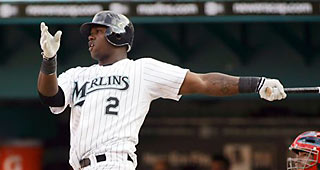
The only player whose power potential exceeds that of Pedro Alvarez is none other than the Incredible Hulk clone otherwise known as Mike Stanton. Marlins fans have been waiting with baited breath for what they perceive as the next in the long line of great Marlins prospects that flourish at the major league level. Ever since he clubbed 39 home runs as an 18-year-old in A ball, scouts have salivated at the thought of the pain that Stanton might inflict on major league pitching.
Stanton has not disappointed in his first season in the bigs, as he has hit a home run once every 19.8 plate appearances, a better rate than such sluggers as Ryan Howard, Prince Fielder and Adrian Gonzalez. Similar to Alvarez, making contact has been as issue, but what Stanton has showed in his 20-year-old season (he doesn?t turn 21 until November) proves that good things are on the horizon.
Madison Bumgarner (-4.4)
Ranked as the 14th best prospect in baseball before 2010, Bumgarner lost some of his luster early in the season as his decreased fastball velocity had the Giants organization worried. However, it was revealed that he had personal problems during the offseason, not to mention that he also got married. Once he got back into the swing of things, his old self resurfaced. Once there was an opening in the Giants? rotation, they turned to their prized lefty to fill the fifth starter spot.
If you take out one clunker of a start versus the powerful Reds? lineup, he has compiled a 3.07 ERA in the rest of starts. A couple aspects of his game that have differed from how he performed in the minors are his decreased strikeout rates and the fact that he has been prone to giving up the long ball. Having just turned 21, there is plenty of time to figure out how to limit the home runs, but the lower strikeout totals might be the norm going forward.
Carlos Santana (26.14)
Santana will forever be linked to Casey Blake, the man he was traded for in what might figure to be one of the more lopsided trades in recent memory. Santana is everything you look for in a catcher: above average defensively, switch-hitter, patience and power. Before his season ended prematurely due to a grizzly collision at home plate, of which he definitely got the worst, he was well on his way to posting some impressive all around numbers. Most impressive, especially for a player so young, is the selectivity he possesses at the plate.
While it may be a tough number to sustain as he moves forward in his career, he walked in 19.3% of his plate appearances, which leads all of MLB hitters with at least 190 plate appearances. The Indians are confident, given that Santana comes back 100% healthy in spring training, that he will be their next Victor Martinez, with the added bonus of actually being able to play defense.
Neftali Feliz (35.55)
Feliz is one of the few players on this list that we actually had a chance to get a preview of late last season, and all he did was whet Rangers fans? appetites for their ace of the future. Texas decided that he would be best utilized in the closer role this season, however, and it has proven to be a solid decision with how dependable the rotation has been as is given the surprising success of the C.J. Wilson, Tommy Hunter, Colby Lewis trio. Feliz has provided stability to the back end of the bullpen with his electric fastball, a pitch that he relies on almost exclusively, averaging better than a strikeout per inning. Opposing hitters also have a batting average below the Mendoza line, a paltry .197.
Personally, I am hoping to see this youngster in the starting rotation next summer, but easing him in at the major league level with a low innings total in 2010 was probably the prudent decision when considering his long-term development.
Starlin Castro (37.49)
The youngest player spotlighted in this column, Castro has future star written all over him. Also the youngest player currently in the major leagues, he has taken a stranglehold on the number two spot in the lineup and doesn?t seem intent on letting go anytime soon. And why should he? He has the best batting average, second best on base percentage and second best OPS of any shortstop in baseball with at least 400 plate appearances.
What?s more, Castro?s defense has been solid, but some see Gold Gloves in his future with the athleticism he possesses. If Castro continues to produce as prolifically as he has on offense while playing a premium defensive position, the Cubs can rest assured that they have a gem of a player on their hands. By the way, this kid can?t even legally step inside one of Wrigleyville?s famed watering holes until spring training of 2011.
Jason Heyward (37.92)
When Jason Heyward went deep in his first major league at-bat on opening day, it seemed as if all of the hype that was built up throughout the offseason and spring training was validated in one fell swoop. While there have definitely been soft spots in his 2010 campaign, overall he has turned in an outstanding and well-rounded season in which he was all of 20 years old for the majority of.
Ranked as the number one prospect prior to the season, Heyward has accumulated a slash line of .284/.392/.484, and has also played a stellar defensive right field. It is appearing as if the ?can?t-miss? projections were right on the money. What was so surprising to me in the time that I have watched him this season is the ability to hit, and hit with power, to all fields. I see the home run numbers increasing in the coming years, as he has only hit a modest 16 this year thus far.
Logan Morrison (39.97)
While teammate Mike Stanton was ranked ahead of him as a prospect, the 20th ranked Morrison?s all-around offensive game has proven to deliver more immediate returns at the major league level. The power that he displayed in the minor leagues hasn?t materialized yet, as he has only hit one home run in 149 plate appearances thus far. That doesn?t mean, however, that he hasn?t been a force at the plate in his rookie season. Morrison has tallied a slash line of .293/.403/.421, proving that him and Stanton could be a duo that opposing pitchers dread facing in years to come. Well, that is, until the Marlins trade him. Almost exclusively a first baseman in the minor leagues, Morrison is trying to learn how to play the outfield on the fly.
Buster Posey (51.77)
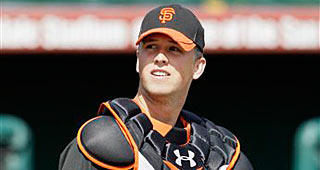
Some call him the player that has single-handedly saved the San Francisco Giants season. Some are already calling him the Rookie of the Year. What everyone might be calling him within a year or two, possibly sooner, is the best all-around catcher in the National League. After watching Posey play, it is hard to pick apart his game and find something that he doesn?t do well. He hits for average and power, blocks balls well and has a cannon for an arm, has a tremendous eye at the plate as well as one of the best opposite field power strokes that I have ever seen. It is hard to believe that Brian Sabean and company didn?t think Posey was ready to break camp with the big club out of spring training, but the presence of Bengie Molina surely had something to do with it. He has batted all over the lineup, but that hasn?t affected his swing as he has accumulated a slash line of .329/.375/.503.
Stephen Strasburg (62.12)
There isn?t really much to be said about Strasburg that hasn?t already been uttered ad nauseum, including the fact that it is not only unfortunate for the Washington Nationals organization that he will likely be undergoing Tommy John surgery and miss 12 to 18 months, but equally unfortunate for the rest of MLB?s viewing public as well. Strasburg was a mythic figure, prior to arriving in the big leagues, whose actual performance exceeded that of his hype. Nationals fans must have felt like they had been punched in the gut the day the unfortunate news came down.
Any starting pitcher that posted the following numbers, much less as a 22-year old-rookie, would deserve any and all praise coming his way: 12.18 strikeouts per nine innings, .226 batting average against, 1.07 WHIP, 5.41 strikeout to walk ratio and a 2.91 ERA. Only time will tell if will be able to battle back from the significant tear in his ulnar collateral ligament to regain his form. I?m sure everyone in baseball will be rooting for him to do so.
? The 2010 seaosn has been historic for rookies who have proven themselves ready for the bright lights at such young ages. In five, ten, even 20 years from now, we might look back on this class of ballplayers and deem them one of the best groups of rookies to ever descend upon MLB in the same season. Or we might not. Baseball is a fickle sport. One day, everything a player touches may turn to gold, other days, not so much. Just ask Steven Strasburg.
More stories: