RealGM Analysis
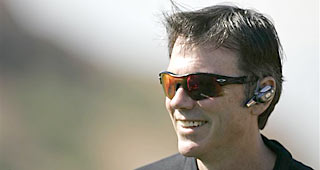
In 2003, Michael Lewis wrote Moneyball, the story of how Billy Beane and the 2002 Oakland Athletics changed the landscape of baseball forever.
Lewis wrote that Beane believed that the current consensus of baseball insiders was flawed. People were too busy focusing on stolen bases, batting average, home runs, and runs batted in to name a few. Teams all over Major League Baseball were paying top dollar for players who put up gaudy numbers year in and year out.
Beane introduced a new strategy.
Instead of investing in popular stats, Beane searched for undervalued players that contributed in ways often not shown immediately on paper. He did this by utilizing sabermetrics. Sabermetrics, as defined by legendary baseball writer and statistician Bill James, who later went on to work in the Boston Red Sox front office, ?the search for objective knowledge about baseball.?
By applying the principles of sabermetrics over the years, Billy Beane has unearthed a new way for a franchise to be run. Consider this: the 2002 A's won 103 games with a $41 million payroll, while the New York Yankees with a payroll of over $125 million finished with an identical record, thus proving that big, traditional offensive numbers were not the key to winning as previously thought.
Manager Art Howe was simply there to execute Beanʼs plans, not to instill his own. Beanʼs ideal ?Moneyball? player was Kevin Youkilis, whom he dubbed ?Euclis, the Greek God of Walks" due to his knack for getting on base. Youkilisʼ career on base percentage? An outstanding .394.
The impact of Moneyball on baseball has been widespread. Numerous teams have gone on to hire full-time Sabermetric analysts, with their lone job to find undervalued players on the market. One of these teams is the Toronto Blue Jays. Former Toronto general manager J.P. Ricciardi had worked closely with Billy Beane in Oakland. Ricciardi originally broke into the Aʼs front office in 1996, when he became special assistant to Athletics general manager Sandy Anderson who was later replaced by Beane. Upon leaving Oakland, Ricciardi's arrival in Toronto was greeted with great hope and optimism for the team as he had had such success in Oakland. That quickly vanquished however, as the team repeatedly failed to match expectations. Fourteen years after that first job with the A's, Ricciardi is entering his first season as the assistant to new Mets general manager, the same Sandy Anderson.
In 2004, the Aʼs traded pitcher Mark Mulder to the St. Louis Cardinals for Dan Haren, Kiko Calero and Daric Barton. Barton, in 2010 hit .260 but drew 110 walks, leaving him with an impressive .393 on base percentage while playing first base for the Aʼs.
While thoroughly reviewing the Aʼs opening day projected starters for 2011, only outfielder Chris Carter has a weak on base percentage, although he only appeared in 24 games in 2010. Reaching base safely could potentially mean the difference of scoring or not scoring a handful of more runs per season, which in turn could make the difference from finishing the season after 162 games, or making the postseason, something the Aʼs are trying to do for the first time since 2006.
Nine years since the debut of Moneyball, both in bookstores and on the field, it is still practiced, albeit on a broader scale as numerous teams search for undervalued players.
The 2011 Oakland Athletics are somewhat reminiscent of the 2002 team. The new faces, notably Josh Willingham, David DeJesus, and Hideki Matsui have career on base percentages of .367, .360, and .369 respectively. According to Beane, as well as sabermetrics, on base percentage should have replaced batting average as a state because it measures the most important piece of information in the game: whether or not a player reaches base safely. Batting average is archaic. On base percentage is what matters in the world of ?moneyball?.
While the focus in Oakland has been about getting on base and undervalued players in recent years, something that makes them a potential playoff contender for 2011 is their pitching. With a major league leading 3.47 ERA in 2010, the Aʼs rotation is looking to be even better in 2011. With Trevor Cahill, Dallas Braden, Gio Gonzalez and Brett Anderson all returning, the Aʼs staff could be a powerhouse this season.
A familiar face is also back with the team: Rich Harden, who last played for Oakland in 2008 before being traded to the Chicago Cubs. With new additions Grant Balfour and Brian Fuentes in the bullpen, as well as a healthy Andrew Bailey closing games out, Oakland could have another breakout year. "You don't have a (Albert) Pujols in there, a flat-out superstar, but if you look at this lineup you have balance," Josh Willingham said this offseason.
Balance. Something that Billy Beane craves.
More stories: