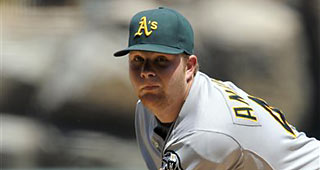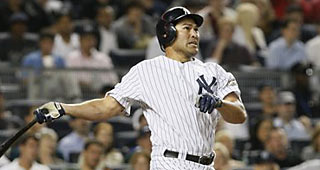
The Yankees have ended Johnny Damon's tenure in pinstripes by signing Randy Winn to a one-year contract worth $2 million.
Before debating the merits of how much the Yankees have significantly downgraded offensively by letting Damon walk, it must be said that Damon's four seasons in the Bronx were highly productive. He signed a four-year, $52 million deal with the Yankees after Boston held steadfast in offering just three seasons, believing that his production would decline quickly at 34 or 35.
Damon had an OPS+ of 114 (.821 regular OPS) during his four seasons with the Yankees, which was 35th overall amongst hitters with at least 2,000 at bats during the timeframe.
But to Boston's credit, Damon was unable to remain in center field defensively for the length of his contract and they weren't anticipating an early divorce from Manny Ramirez that would have allowed Damon to play the short left at Fenway. The Yankees were able to shift him to left field, where Hideki Matsui was no longer able to play and though his arm remained famously horrible, he wasn't a complete liability. Damon was very capable in left field during the 2007 and 2008 seasons, but he fell badly in 2009 with a -12.1 UZR/150.
While nobody expects Winn to replicate Damon's production at the plate, he is still a very good defensive outfielder. He has been well above average in both outfield corners. The Yankees have an inordinate amount of strikeout pitchers, which takes some of the onus off their defense, but it has been something Brian Cashman has stressed heavily over the past few seasons.
Winn's OPS dropped over 100 points from 2008 to 2009, going from .790 to .671. He experienced big drops in his power and also OBP, striking out with greater frequency (17.3%), walking less and also seeing a drop in his BAbip to .314.
After a 2007 in which Damon's OPS his a rock bottom of .747, he rebounded in each of the past two seasons with an .836 in 2008 and .854 in 2009.
Since he won't be hitting in Yankee Stadium (perfectly structured for his swing) and between Derek Jeter and Mark Teixeira, his numbers will likely drop in 2010 wherever he ends up signing.
Grade for Yankees: B-
While the Yankees were clear they wanted to significantly reduce Damon's 2010 salary from where it was, they did appear genuinely open to a one-year deal. Damon wanted to remain with the Yankees and the fact that he still hasn't signed with anyone else tells me he is still a little shell-shocked from what happened and also that Scott Boras overestimated the potential alternatives.
Grade for Damon: D
Grading The Deal: Vazquez Rejoins Yanks Rotation
The Yankees continue to turn back the clock, this time trading Melky Cabrera, Mike Dunn and prospect Arodys Vizcaino for Javier Vazquez and Boone Logan.
Vazquez, who was the Game 7 starter in the 2004 ALCS, has a career ERA of 4.19 and is coming off a career best mark of 2.87 with the Braves. He has an excellent strikeout pedigree, with a career K/9 of 8.1 and 9.8 last season. This should make his transition back to the AL East at least a little easier, even if he has a propensity for the fly ball.
Vazquez has been one of the game?s most durable starters, making no fewer than 32 starts in any single season during the decade we are now saying ?goodbye? to. He is a 200+ innings per season pitcher without question.
Brian Cashman reluctantly dealt Vazquez on Steinbrenner orders in the ill-conceived trade that sent Randy Johnson to the Bronx. Vazquez had made the All-Star Game in that lone season with the Yankees before unraveling in the second half and in the playoffs.
We can reasonably expect a regression from Vazquez this season; he wouldn?t duplicate his 2.87 ERA again in the NL East, let alone the AL East, but an ERA around 4.00 is almost a given and the Yankees will take that from a number three or four starter.
Vazquez is also in his walk year, which will pay him $11.5M, making him a much cheaper alternative to John Lackey, who signed with the Red Sox this winter. The Yankees will almost certainly offer him arbitration in the winter and if a deal isn?t done, they can recoup some of what is lost through compensatory picks.
Losing Cabrera is unfortunate, as he became one of the heart and soul members of the Yankees and it was nice to see the team have a legitimate role player amongst their roster of All-Stars. But after a highly disappointing 2008 in which he had an OPS of .641 (.301 OBP), Cabrera had to beat out Brett Gardner to win the center field job. He did just that, hit for an OPS of .752 and played a respectable, albeit underwhelming defensive center field.
With the Curtis Granderson trade, however, the Yankees would have moving him to left field, but under any criteria, Cabrera would be a below average corner outfielder at the plate. The strides he made in adapting the Yankees plate approach of patience made a tangible difference in his production, but he is still a long ways away from an .800 or better OPS hitter, which is practically mandatory to wear pinstripes.
The Yankees can possibly re-sign Johnny Damon now, or even enter the Jason Bay or Matt Holliday market, though they appear handcuffed by their payroll and Gardner could be a one-year stopgap.
Cabrera?s game has always been better suited for the NL, though he won?t be hitting ninth as he moves up closer to the middle of the lineup.
Vizcaino was one of the Yankees most highly touted prospects and projects as a potential ace, but he is just 19 and is a long ways away.
For all of the frequent complaints about the Yankees? payroll, Vazquez unquestionably represents a sense of frugality on the franchise?s part. The Yankees could have packaged Cabrera, Vizcaino and perhaps Jesus Montero in a deal for Roy Halladay, but the exorbitant price tag of an extension made that almost impossible due to their payroll already hovering at the $200M mark.
A rotation of CC Sabathia, Roy Halladay, AJ Burnett, Andy Pettitte and either Phil Hughes or Joba Chamberlain would have been the closest thing to a lock to win another World Series as we?ve seen for decades.
Vazquez bolsters the rotation and is a pitcher any manager will have confidence in sending to the mound, even in a playoff game, but he is certainly not Halladay.
Grade for Yankees: B+
The Braves had a surplus of starters, so this deal is mostly about finances for them. The Yankees will pay Vazquez?s entire salary, so they will have several million to spend elsewhere. Trading Derek Lowe was not an option due to his salary over several seasons and keeping Vazquez and then letting him walk in return for two draft picks wouldn?t have helped them as much as this trade does.
Dunn is a 24-year-old southpaw reliever who looks like he will have a productive career if he can ever improve his command and lower his walk rate.
The real knock on this trade comes from the fact that they signed Lowe to such a monster contract last winter and forced Frank Wren?s hand with this deal.
Grade for Braves: C+
 RealGM Analysis

More stories: