RealGM Analysis

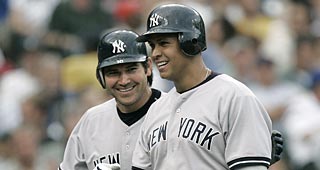
New Yorkers are familiar with the daily battle for the sports headline on the back pages of the city?s tabloids. Throughout the year the Giants, Jets, Knicks and Mets all receive their fair share of coverage, but the summertime seems to centers on the daily activities of the Yankees. The past few weeks these headlines have focused on possible Yankee moves at the baseball trade deadline, culminating with slugger Bobby Abreu?s arrival in the Bronx to dawn the pinstripes. It?s nothing new for Yankees? General Manager Brian Cashman to pick up big bats like Abreu midseason (think David Justice and Raul Mondesi in years past), but this recent trade got me thinking about another New York sports team whose executive acquires talent no matter the price.
No sports fan would ever mention Cashman and Knicks? President Isiah Thomas?s success records in the same breath. Since 1998, Cashman has enjoyed three World Series championships, five American League Pennants, and division wins every year. Isiah Thomas?can?t say the same. Considering the miles separating their team?s performances during their tenures, it is surprising that both Thomas and Cashman manage their rosters in similar fashion.
As the men in charge of the day-to-day operations of the ?marquee? franchise of their leagues, both Cashman and Thomas benefit from the unlimited budget the New York media market provides. Their respective owners, George Steinbrenner and James Dolan, don?t seem to mind footing the bill no matter how fiscally irrational their moves appear. The Yankees essentially paid twenty million in cash to acquire Abreu for the second half of the season pennant race with the Red Sox. Most teams and general managers wouldn?t dream about picking up that much salary, but like Isiah Thomas, Cashman subscribes to a ?Spend Now, Ask Later? management policy. Usually a team coming off a deep postseason run picks up a utility infielder, or a pitcher for the fourth slot in their rotation to retool for next year; the Yankees pick up Randy Johnson, Carl Pavano, and Jaret Wright?s total of around one hundred million in salary and revamp their whole pitching staff. Similarly, Isiah Thomas disregards his league-high salary cap and picks up fifty million dollar contracts without so much as a blink of an eye.
If both Cashman and Thomas appear to use the same tactics to build their franchises, why is one the butt of jokes on Around the Horn and Pardon the Interruption, while the other?s hand is feeling heavy from all the rings he has won? The answer lies in the inherent differences between the structure of baseball and basketball. To illustrate, look at the way?s one might see Cashman and Thomas?s tactics described from your average radio call-in show: ?Isiah Thomas is picking up bad contracts and ruining the Knicks future,? whereas ?Brian Cashman?s limitless spending is unfair to other teams.? The difference is that in baseball there is no hard salary cap. The Yankees and Brian Cashman can spend as much money as they want in upgrading their roster as long as they are willing to be taxed after a certain point. On the other hand when Isiah Thomas adds a contract to the roster he makes it that much tougher for the Knicks to maneuver later. When Cashman made the regrettable decision of signing Carl Pavano, he didn?t ruin the Yankees ability to sign a replacement if he didn?t pan out, but when Isiah acquired Jerome James last summer, he had committed himself to a player he soon didn?t want and couldn?t get rid of. The structure of the NBA salary cap makes Isiah?s Cashman-like spending questionable when it doesn?t produce wins.
In addition to the unique structure of each sport, Isiah?s problem has been his belief that the team with the most talent must win. Basketball is more of a team-oriented sport where on-court chemistry is as essential as scoring. Trading Trevor Ariza for Steve Francis this past season seemed like a steal on paper; a role-player for an all-star, but the Knicks added Francis to a crowded backcourt with similar abilities and gave up one of their only defensive-minded players. In baseball a manager can and will always adjust his lineup to find a way to add a home-run hitter such as Bobby Abreu because he provides a better chance to score in his one-on-one match up with the pitcher, but just plugging in a more talented scorer in basketball certainly doesn?t translate into success.
This argument isn?t to say that Isiah is managing the Knicks as if he were in the MLB instead of the NBA; it just offers a reason as to why two managers who use similar methods are achieving different results. An alternative explanation is that both Cashman and Thomas?s performance should be attributed to their predecessors. First, Thomas inherited the worst salary cap situation in professional sports from Scott Layden, and to his credit turned the bloated contracts of veteran role-players into the bloated contracts of exciting and talented younger pieces. With the Knicks always too far over the cap for repair, why not just try to improve the team without regard to the money? On the other side, Cashman has been the beneficiary of his predecessor?s excellent management of the Yankees minor league prospects. The Yankee dynasty that Cashman oversaw was built with homegrown players that were already in place like Derek Jeter, Mariano Rivera, Andy Pettitte, and Jorge Posada. In fact, since Cashman started acquiring stars like Jason Giambi, Kevin Brown, Gary Sheffield, and Alex Rodriguez the Yankees haven?t won a World Series.
The truth is every team in professional sports has their own management philosophy put in place from the top-down. Certain teams will pay anything to win, certain teams stay at the cap level as to not be taxed, and then of course there are the odder systems like Billy Beane with the Oakland A?s, and the Florida Marlins twice winning World Series and blowing the team up to restart immediately after. What the public opinion of these managers comes down to isn?t the money, but the performance. The average fan doesn?t care if the team teeters between the red and the black; he cares if the team teeters under/over .500. Brian Cashman?s teams have won. Isiah Thomas?s teams have lost. Until this changes, no home run hitter or all-star point guard will affect their reputations; but they?ll both spend millions trying.
Please email any questions, comments, or feedback to [email protected]
More stories: