RealGM Analysis

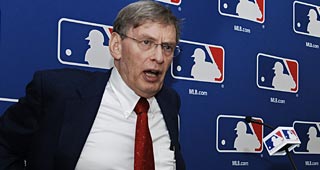
Hometown fans from around the nation and parts of Canada unceasingly blame Bud Selig and the MLB for not limiting the payrolls of the "big-time" organizations, such as the Red Sox and Yankees, which they believe are "ruining baseball". Taking a glimpse at the payroll of the Yankees, $198,662,180, and then scrolling-down to find the Marlins' at $14,344,500 and instantly think, "How does George Steinbrenner get away with this?"
But the question that they should really be asking isn't how Steinbrenner, the overzealous owner of the New York Yankees, gets away with paying-out that much money, but rather how Jeff Loria, Steinbrenner's foil character and manager of the Florida Marlins, gets away with paying-out less money than the salaries of 12 MLB players alone.
While Royals fans such as Chad Carroll auctions off 25-years of loyalty to their, formerly, favorite teams on eBay, the Red Sox have sold-out more consecutive games than dollars Mike Sweeney paid in income taxes last year. But how could this be? How could these Red Sox fans condone the "ruining" of America's favorite pastime? How could any real baseball fan support these "evil" organizations which seek only to shatter the seasons of all of the "innocent" small-town teams?
The truth, however, is quite the contrary. In fact, the MLB is discussing the implementation of new rules to require the owners of such small-town organizations to re-invest a higher percentage of their teams' profit back into the franchise. In other words, while George Steinbrenner and John Henry, the Red Sox owner, put every last penny they make back into their organization's payroll, the MLB has to manipulate the rules just to insure that owners such as Stuart Sternberg of the Tampa Day Devil Rays don't chose to pocket that money instead. Why do you think that Jeff Loria depleted the Marlins of their high-paid players? If you're thinking what I'm thinking; you're right. Take this chance while you have it, because there aren't many other times that you can call multi-millionaires cheapskates.
And sure, you can point to the big-money-markets that are New England and New York; but, as the famous movie line goes, "If you build it, they will come," and the antecedent to 'it' in this case is the franchise. When the Royals win 100 games, and they still aren't attracting fans, then you can come and yell at the Red Sox and Yankees -- but, I can say with relative certainty that if the Royals do win 100 games, Kansas City will join New York and Boston as a big-money-market.
The problem isn't the dollar-amount that these owners invest, but rather the percentage-of-profits that these owners invest. The MLB can continue to take money out of the Yankees' TV and media contracts and distribute it to the lower-budget teams -- that's not going to stop George Steinbrenner from taking every dollar made and putting it back into the organization. But the lesser-owners can sit back and squeeze the profits out of their respective organizations, and if a question is ever raised; they can simply point at the Yankees and say, "Look at all that money that he's spending!"
I'm not going to sit and feel sorry for the millionaires and billionaires who own MLB franchises because they want to make a quick-buck -- that's not how to win-over a city. You can yell at Tom Hicks as much as you want for his negotiations with Scott Boras and previous signing of Alex Rodriguez to a 10-year, $252 million contract -- but at least he was trying to improve the Rangers, instead of pinching-pennies. Having no salary cap is the best thing that's ever happened to baseball -- it promotes the sport and the media coverage of it, and that's all that counts.
If you want your MLB team to be a successful one, you have to spend money -- that's what you agree to when you purchase one of these massive franchises. And sure, you're not going to make much money while you're the owner, but last time I checked, the Yankees are the only MLB franchise worth over a billion dollars. When you invest money in a franchise, as in any other type of business, and your investment pays-off ala World Series, you're going to make money -- but, if you'd rather take no risks, why did you invest in the first place? No guts, no glory -- no risk, no reward -- it's as simple as that.
Questions, Comments, Concerns, Criticisms, Critiques: `[email protected]
More stories: