RealGM Analysis
The games are starting to mean more and more as the summer approaches. The season is more than one-third of the way through and the haves and have-nots have been established.
The First-Year Player Draft
I attended the 2009 First-Year Player Draft in New Jersey three years ago when Major League Baseball began an attempt to make the annual event must-see television. It is not there yet, but steps are being made as we saw earlier this week.
There were five players present for the first-round on Monday night, including first overall pick Carlos Correa (Astros). Back in 2009, the Nationals took Stephen Strasburg and he was nowhere to be found. Mike Trout, the 25th overall pick by the Angels, attended the event and that was only because he is from Millville, New Jersey.
Bud Selig has done wonders for baseball, but is out of touch in regards to what attracts fans to the draft process. The event continues to gain traction, but the nature of the selection process does not lend itself to great theater. The initial night (comprised of the first round and compensation) has to be the focus as the draft itself goes on too long to maintain a significant level of interest.
Of the 32 players that were drafted in the first round three years ago, only ten had reached the Major Leagues as of Wednesday. Baseball lacks the immediate gratification fans get from watching the NBA and NFL drafts. Those rookies often make an impact five months later.
Ian Kennedy Regresses
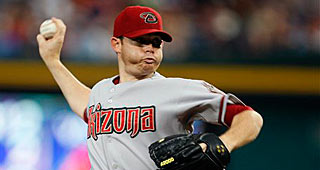
The right-hander lit the National League on fire last season, going 21-4 with a 2.88 ERA and 198 strikeouts in 222 innings for the Diamondbacks. It was by far the best season of his Major League career.
Through 12 starts in 2012, Kennedy has regressed. He is 5-5 with a 3.93 ERA and 71 strikeouts in 75-plus innings. His strikeout rate is a bit better than it was last season, but his ERA has increased 36.5%.
The issue has been that when hitters make contact, they are having success against Kennedy. Opposing hitters have a line of .270/.320/.454 and he has surrendered nine home runs. He is on pace to allow 27 dingers after allowing 19 last season. His numbers look an awful lot like they did in 2010 during his first run with Arizona.
He went 9-10 with a 3.80 ERA in 32 starts the season after being dealt by the Yankees.
Pirates Unable To Loot For Offense
The 1992 season was the last time Pittsburgh put together a winning season and their 28-26 record entering Wednesday has them in danger of stretching a historic run of futility to two decades. The Pirates have been carried by their pitching staff in 2012 with an ERA (3.26), batting average against (.240) and WHIP (1.26) among the top ten in baseball.
This season, they have been plagued by a poor offense. They have scored a Major League-low 170 runs and as a team they are hitting just .223/.277/.361.
Andrew McCutchen has produced, .333/.392./.556 with nine home runs and 30 RBI, but he has not enjoyed much help. Neil Walker (.267/.322/.361) has the second-best batting line on the team and four regulars own a batting average lower than .220.
Carlos Quentin might be an option for the Pirates at midseason. A bat might be all they need to finally finish a season above .500.
Jeter Coming Down To Earth
Derek Jeter was hitting .400 as recently as May 4, but he was not nearly as hot last month as he was in April. The shortstop, who was drafted by the Yankees twenty years ago this week, hit .389/.433/.579 with four home runs and 13 RBI in 95 April at-bats.
In May, he hit .293/.339/.353 with one home run and five RBI in 116 at-bats. From April 30 to May 30 his batting average dropped from .389 to .336. Before hitting a home run on June 3 against the Tigers, he had not hit a ball out of the ballpark since May 4 in Kansas City.
He has four hits in 12 at-bats so far in June, but his numbers are no longer career bests and his incredible early-season power numbers have diminished.
Dealing Edwin Encarnacion
In the blogosphere the question has been proposed -- should the Blue Jays trade Edwin Encarnacion this summer?
He is hitting .279/.348/.578 with 17 home runs and 43 RBI as a designated hitter and can become a free agent after the 2013 campaign. Some have suggested that Toronto could extend his contract, but others want the Blue Jays to deal the 29-year-old for depth and prospects.
Extending Encarnacion during the season would be a mistake for the Jays, who have become competitive in the American League East. They would be paying him based on prorated numbers during his best season without much of a safety net in terms of absorbing a bad contract.
With that said, dealing him may not be a wise move either. Toronto entered action on Wednesday just two games out of first place and the three division juggernauts (Boston, New York and Tampa Bay) have all battled injury and consistency issues.
The best course of action?
Wait to see if Encarnacion can sustain this level of play over a full season and broach the subject of an extension this winter. Maybe his value drops a bit and he can be retained over the next three or four years for $7-$8 million annually instead of $10 million.
Give him time to establish true market value.
Andrew Perna writes on the MLB and NBA for RealGM.
Follow @Andrew_Perna on Twitter.